Muay Thai in 1910: The Official Document Recognizing Three Regional Masters
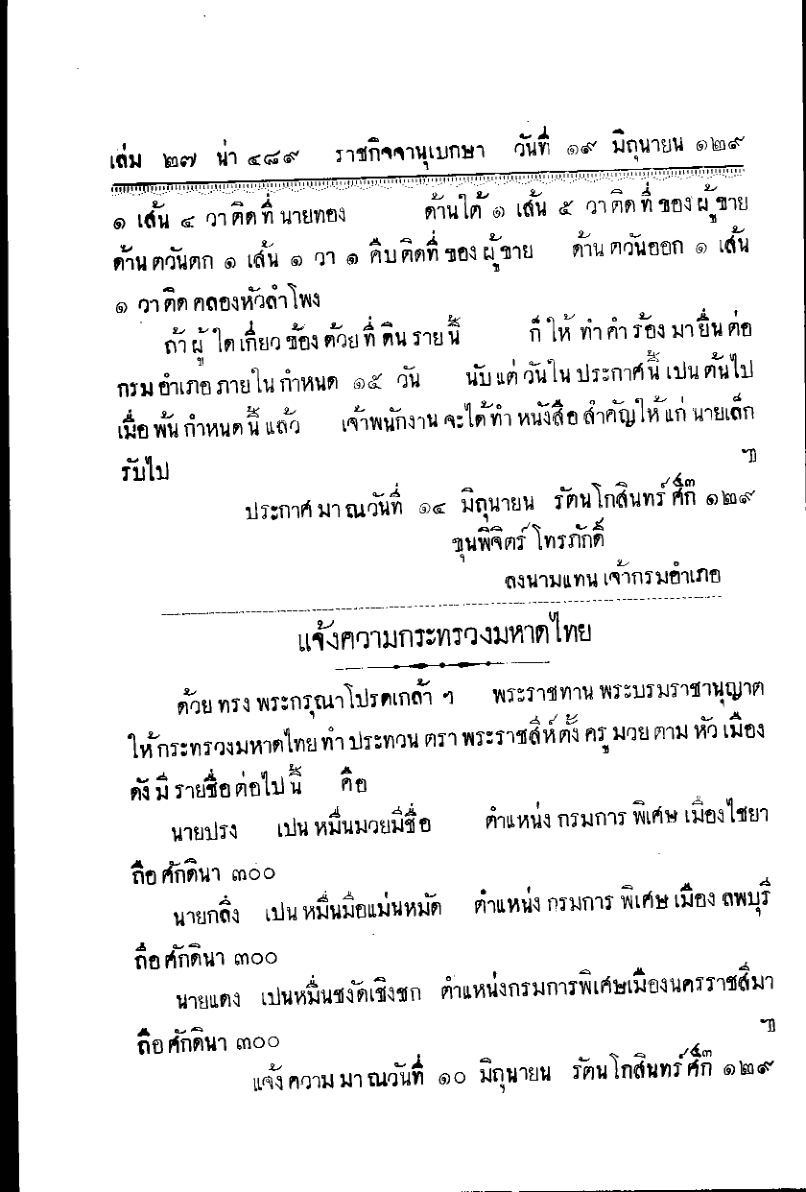
On June 19, 1910, a page from the Royal Gazette, the official government publication of Siam, recorded something particularly significant for the history of Muay: the granting of official titles to three fighters associated with different cities in the kingdom.
This document is not a chronicle written decades later, an orally transmitted genealogy, or a contemporary reconstruction of Thai martial traditions. It is an administrative record published during the reign of Chulalongkorn, Rama V, identifying three men, their titles, and their local roles.
More importantly, the announcement states that the initiative aimed to preserve the art of Muay in regional cities, preventing it from deteriorating or disappearing.
The discovery provides a concrete documentary reference for investigating the relationship between regional combat practices and the policies of the Siamese state in the early 20th century.
The Original Document
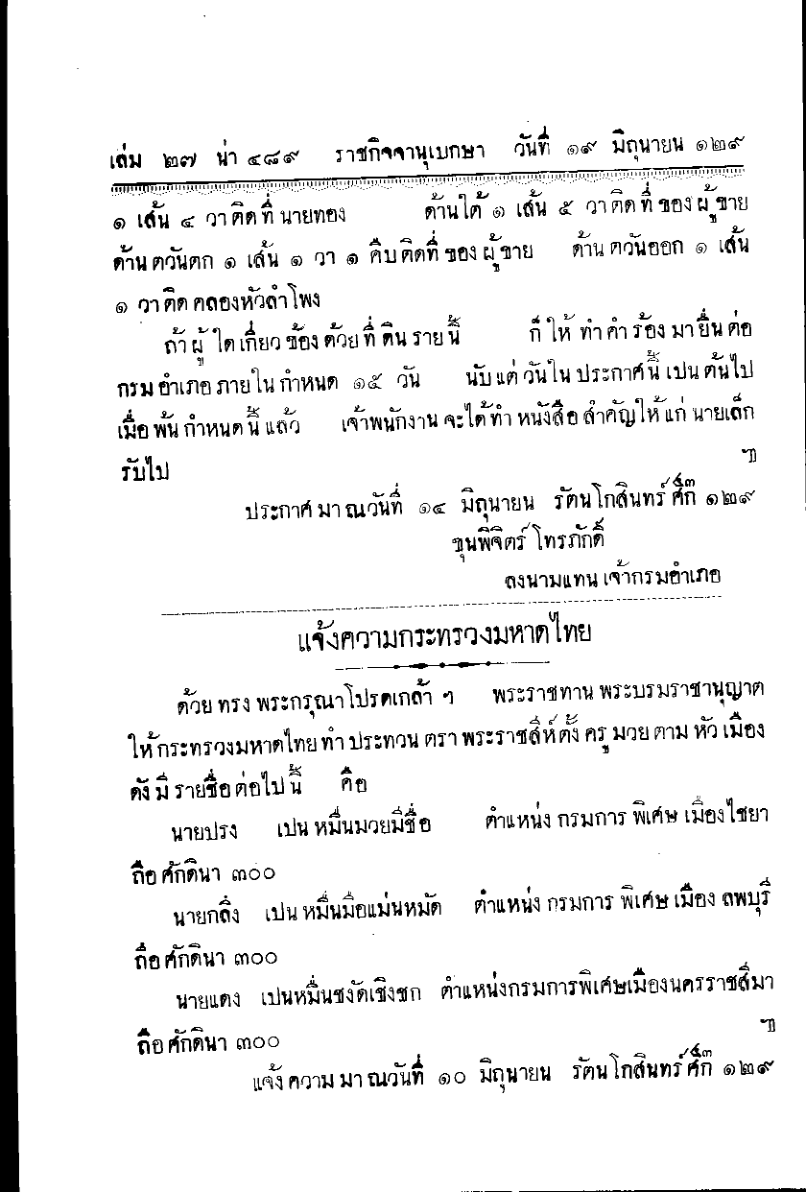
The page features the header แจ้งความกระทรวงมหาดไทย (Announcement from the Ministry of Interior). It states that, by royal decree, the Ministry was to formalize the appointment of Muay masters in the cities of the kingdom.
The text lists three names and their respective official titles. This is important evidence as it allows us to see how these fighters were recognized by the public administration, beyond later narratives about their skills and lineages.
The Three Fighters and Their Official Titles
1. Prong — Muen Muay Mi Chue, from Chaiya
The document identifies the first fighter as นายปรง (Nai Prong) and records the title:
หมื่นมวยมีชื่อ — Muen Muay Mi Chue
This title can be roughly interpreted as “Muen, the renowned boxer.” The translation is approximate, as traditional Siamese titles have their own conventions and do not always correspond literally to modern expressions.
The announcement associates Prong with Chaiya, in the southern region of present-day Thailand, and assigns him a special position in the local government.
In modern historiography of Muay, this man is identified as Prong Chamnongthong, known for his association with the Chaiya tradition. However, the official page uses only the name Prong. The correspondence between the abbreviated name and the full name should be supported by cross-referencing with other sources.
2. Kling — Muen Mue Maen Mat, from Lopburi
The second name is นายกลึง (Nai Kling), who received the title:
หมื่นมือแม่นหมัด — Muen Mue Maen Mat
This expression is associated with the precision of hands and fists. In modern translations, the title is often interpreted as a reference to the fighter with accurate hands or fists.
The document links Kling to the city of Lopburi, an important political and historical center of Siam. It also assigns him a special role in the local administration.
Later sources identify this fighter as Kling Tos-a-at, a figure associated with the modern tradition of Muay Lopburi. This identification is consistent with retrospective documentation, but it is important to note that the full name does not appear on page 489.
The historical value of the record lies precisely in what it directly confirms: in 1910, a fighter named Kling received an official title and was associated with the local government of Lopburi.
3. Daeng — Muen Changat Choeng Chok, from Korat
The third fighter is listed as นายแดง (Nai Daeng) and received the title:
หมื่นชงัดเชิงชก — Muen Changat Choeng Chok
This title relates to skill or dexterity in boxing combat. As with the previous cases, its exact translation requires care with the vocabulary of traditional Siamese titles.
The announcement associates Daeng with Nakhon Ratchasima, also known as Korat, a strategic region of the Khorat plateau.
In modern literature on Muay Korat, this fighter is identified as Daeng Thai Prasert. Again, the official document provides the short name; the complete identification depends on comparison with other sources.

Fairtex Glory Training Gloves
Premium Craftsmanship: Elevate your training with Fairtex, a renowned brand since 1971. Our boxing glove, handcrafted in Thailand, offer exceptional quality and durability
All three men are listed with the same value of sakdina, 300, an indicator of their position in the social and administrative hierarchy of ancient Siam. The document also assigns them special roles in their respective cities.
The Stated Objective: Preserve Muay in Regional Cities
The most significant part of the announcement is the purpose attributed to the ministerial initiative:
ทำนุบำรุงวิชามวยตามหัวเมืองมิให้เสื่อมสูญ
An approximate translation would be:
“Promote and preserve the art of Muay in regional cities, so that it does not deteriorate or disappear.”
This phrase deserves attention because it expresses an institutional concern for the continuity of combat practices outside the political center.
This is not merely about recognizing three fighters for their individual skills. The text frames the appointment as part of an initiative to preserve the art of Muay in the cities of the kingdom.
This detail alters how we can interpret the process of forming modern Muay Thai. The relationship between the state and regional practices should not be reduced to the idea that local traditions simply disappeared in the face of sporting standardization. The document shows, at least in this case, an official initiative for recognition and preservation.
This does not mean that all traditions received the same treatment, nor that the policy was implemented uniformly. It means that, in 1910, there was an expressed concern for maintaining the art of Muay in regional cities.
What the Document Confirms and What Remains Open
The strength of this source lies in what it directly records.
We can state that, in 1910:
the Siamese government published an act recognizing three fighters;
the men were associated with Chaiya, Lopburi, and Nakhon Ratchasima;
each received an official title and a special administrative role;
the announcement declared the purpose of preserving the art of Muay in regional cities.
However, the page does not establish that these three men represented all existing traditions in the kingdom. Nor does it prove that there was, at that time, a formal national classification composed exactly of the four styles Chaiya, Korat, Lopburi, and Tha Sao.
It also does not demonstrate that the techniques later attributed to each tradition were closed, exclusive, or immutable systems.
The distinction is essential: a document confirming the appointment of a master does not automatically confirm the entire technical genealogy that later sources attribute to him.
Why Does Tha Sao Not Appear?
The absence of Tha Sao on page 489 raises an important question. If the announcement recognized masters from Chaiya, Lopburi, and Korat, why does it not mention a representative from Tha Sao?
The answer cannot be deduced solely from this document.
It is possible that the act had a specific scope, that other masters were recognized under different circumstances, or that the Tha Sao tradition was not represented in the same way in this administrative initiative. These possibilities need to be investigated in other documents.
The absence of a tradition in a specific record does not prove that it did not exist. It merely establishes that it does not appear in that act.
This caution is especially important for research on Uttaradit, Phraya Phichai, and the Liang-Prasert family. Regional genealogies need to be confronted with administrative records, without assuming that modern classifications directly correspond to the organization of combat practices in the past.
A Source to Rethink the Formation of Modern Muay Thai
The 1910 document allows us to approach two dimensions of Muay history.
On one side, we have the masters, their reputations, and their connections to specific cities. On the other, we find the state, which assigns titles, roles, and responsibilities within an administrative structure.
This relationship offers a more complex perspective on the formation of modern Muay Thai. Instead of imagining a simple transition from ancient styles to a uniform national sport, we can investigate how official recognition, local transmission, and sports organization have interacted over time.
The Royal Gazette does not answer all these questions on its own. But it provides a solid documentary point from which we can move forward.
The next step is to locate the administrative requests that preceded the publication, examine competition records from 1909 and 1910, and look for similar acts in other regions. It will also be necessary to investigate when the classification of the four regional traditions began to be presented as a set.
Conclusion
Page 489 of the Royal Gazette, published on June 19, 1910, is a fundamental primary source for our investigation. It records the titles granted to Prong, Kling, and Daeng, associates these men with three cities, and explicitly states the goal of preserving the art of Muay in the regions of the kingdom.
Its significance goes beyond the names and titles. The document shows that the preservation of regional Muay was the subject of an administrative initiative during the reign of Rama V.
We still cannot use this page to prove the existence of a formal classification of four styles, nor to fully reconstruct the technical lineages of the three fighters. But we can assert that the official recognition of regional masters was already documented in 1910.
It is from records like this — confronted with photographs, accounts, genealogies, and other contemporary documents — that we can reconstruct a history of Muay Thai that is less dependent on repeated narratives and more supported by verifiable evidence.
Documentary Reference
SIAM. Royal Gazette. Volume 27, p. 489, June 19, R.S. 129 (1910). Announcement from the Ministry of Interior regarding the appointment of Muay masters in regional cities.
Muay Thai Expert — independent editorial. Affiliate links on product pages are disclosed.